

About Zigbee protocol
Note
Zigbee R22 is currently in maintenance mode, and it is not recommended to use it for new Zigbee designs. While critical bug fixes and security updates will be provided as necessary, it will not receive any enhancements or new features. The Zigbee R23 add-on represents Nordic’s primary solution for future Zigbee developments, offering improvements, support for new features, and support for the nRF52840 SoC and new platforms such as the nRF54L series.
The Zigbee R22 add-on for the nRF Connect SDK uses the ZBOSS library, a third-party precompiled Zigbee stack. It includes all mandatory features of the Zigbee 3.0 specification and provides an Application Programming Interface (API) to access different services. The stack comes with the following features:
Complete implementation of the Zigbee core specification and Zigbee Pro feature set.
Support for all device roles: Coordinator, Router, and End Device.
Zigbee Cluster Library, including Zigbee FOTA.
Base Device Behavior.
Devices definitions for devices that were implemented for Zigbee Home Automation and Light Link profiles.
Zigbee Green Power Proxy Basic.
Experimental support for
ZB_ZCL_WWAH.
Experimental support also means that the feature is either not certified or no sample is provided for the given feature (or both).
See the ZBOSS Zigbee stack page and the external ZBOSS development guide and API documentation for more information about the ZBOSS library.
For more information about Zigbee, download the Zigbee Specification from Connectivity Standards Alliance.
Zigbee topologies
Depending on the available device types and their number, Zigbee supports the following network topologies:
- Star topology
The coordinator communicates directly with the end devices and no routers are actively present, meaning they are either not present or not routing packets within the network.
- Tree topology
The routers are located beyond their mutual radio range and are not able to communicate with each other. However, unlike in the star topology, the routers continue to move packets through the network.
- Mesh topology
This topology allows full peer-to-peer communication.
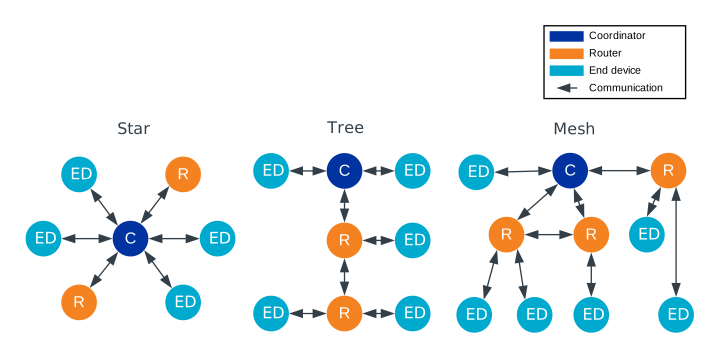
Zigbee topology types
In each topology, the nodes have the following responsibilities:
Zigbee Coordinator - Initiates and maintains the devices on the network. It also chooses the key network parameters. The coordinator’s radio is continuously listening for frames.
Zigbee Router - Extends the range of the network. For this reason, the router has the radio enabled at all times. However, in the star topology it is not moving packets through the network.
Zigbee End Device - Receives messages from the parent device.
In every Zigbee topology, each router and end device that joins the Zigbee network after its creation by the coordinator needs a parent device. When a device wants to join the network, it sends a beacon request to scan for available devices. The devices that can route the packets respond with beacons. Based on different factors of responses, such as signal strength, the new device selects the parent.
For end devices, the parent device (a coordinator or a router) can store information meant for them. This is required because the end devices do not receive packets directly from other devices. Each packet meant for an end device needs to go through its parent, and the end devices need to regularly request and respond to packets from the parents. For example, in the Zigbee R22 add-on for the nRF Connect SDK, the Zigbee light switch device requests packets from the parent every three seconds. The end device does not route packets. It can also disable its radio to reduce the power consumption between the regular packet requests if the Sleepy End Device behavior is enabled.
Additional information
If you want to learn more about the Zigbee topics and terminology mentioned in this guide, read the following pages:
Architectures page to learn more about the Zigbee architecture.
Common ZCL terms and definitions section in the ZBOSS user guide.
Zigbee topologies in section 1.1.4 of the Zigbee Specification.
Sleepy End Device behavior section on the Configuring Zigbee R22 add-on page.