
DECT NR+ RPC
The DECT NR+ RPC library lets an external MCU (without a DECT NR+ modem) use a Zephyr net_if and DECT NR+ shell commands served by the full DECT NR+ stack on an nRF91 Series device over Remote procedure call library (nRF RPC) (typically UART).
Note
The current implementation is experimental.
Overview
Run the DECT NR+ modem and L2 on the nRF91 Series device (server role) and your application on another MCU (client role).
The client gets a tunneled net_if without integrating the modem on that chip.
You need two boards and must accept UART latency and throughput limits compared with a single-chip design (see the DECT NR+ RPC).
The library serializes IPv6 packets, shell commands, and link or address notifications over the transport. Use it when the application runs on a separate MCU while the DECT NR+ modem and stack stay on the nRF91 Series device.
Implementation
The library has a client role, a server role, and shared RPC group code:
Client (external MCU, no DECT NR+ modem) - Tunneled Zephyr
net_if(DECT RPC L2; sample namedect0through theCONFIG_DECT_NR_RPC_CLIENT_IFACE_NAMEKconfig option).Server (nRF91) - DECT NR+ L2 and modem driver decode RPC, inject TX into L2, and mirror RX, link state, and addresses to the client.
Architecture
The following figure shows a logical DECT NR+ device split across an external MCU (application and mirrored net_if) and nRF9151 DK (modem and server dect0), with the over-the-air DECT IPv6 network outside that boundary.
Example wiring uses nRF54L15 DK and nRF9151 DK from the DECT NR+ RPC.
Other external MCU and the nRF91 Series device pairs behave the same way.

Client and server boards and UART RPC link (see body text for data path).
RPC messages
The client sends blocking commands with a response where applicable.
The server sends queued events without a command-style reply.
Command and event names are the DECT_RPC_CMD_* constants in the subsys/net/dect/rpc/common/dect_rpc_ids.h file (internal; not in the public API headers).
The following figure lists them by direction.
The rest of this page refers to the ones that matter for bring-up and data path behavior.
Application IPv6 traffic uses DECT_RPC_CMD_IF_SEND (positive response = accepted byte count, negative = errno).
For that command, the RPC response is returned before the blocking DECT transmit completes on the server.
Client event decoders call the nrf_rpc_decoding_done() function so the transport can receive the next frame.
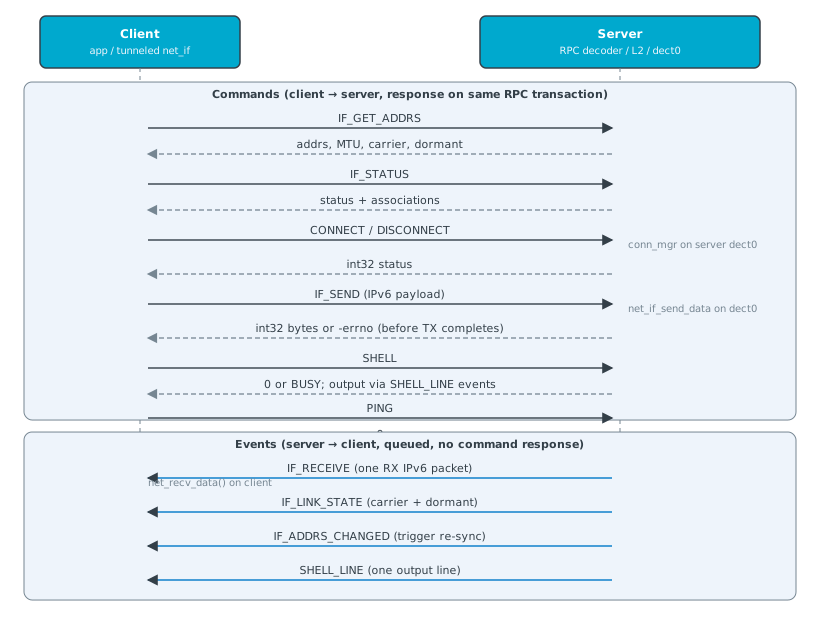
RPC commands (client to server) and events (server to client).
Server L2 integration
On the server, received IPv6 frames are handled in the dect_net_l2_recv() function in the subsys/net/dect/l2/dect_net_l2.c file, not in the modem RX driver alone.
When an RPC client session is active (refreshed on client commands, cleared after CONFIG_DECT_NR_RPC_SERVER_CLIENT_IDLE_TIMEOUT_SEC or RPC re-bind), L2 forwards RX to the client through the dect_net_l2_rpc_forward_register() and dect_net_l2_rpc_client_set_connected() functions instead of processing the packet locally on dect0.
When no session is active, the server handles packets on dect0 as usual.
Link-state and IPv6 address or prefix changes on server dect0 use the dect_net_l2_link_state_register() function and are mirrored with DECT_RPC_CMD_IF_LINK_STATE and DECT_RPC_CMD_IF_ADDRS_CHANGED events.
For DECT_RPC_CMD_IF_SEND, the server builds a net_pkt structure on the DECT interface, derives the DECT destination from the IPv6 destination, and injects the packet with the net_if_send_data() function.
Client network interface
The client does not build DECT NR+ L2 or the modem driver.
It registers DECT RPC L2 (DECT_RPC_L2) and a tunneled net_if only (sample default name dect0).
During net_if initialization, the client sets the NET_IF_IPV6_NO_ND interface flag on the tunneled interface so the Zephyr stack does not run IPv6 Neighbor Discovery locally.
Neighbor Discovery and address management stay on the server dect0 interface.
The client applies addresses, prefixes, MTU, carrier, and dormant state from DECT_RPC_CMD_IF_GET_ADDRS and DECT_RPC_CMD_IF_LINK_STATE RPC events instead.
With the CONFIG_NET_IPV6_MLD Kconfig option set, multicast behavior aligns with native DECT where applicable (including optional deferred join of ff02::fb when carrier is up).
Use different hostnames on the client and server so that the client does not impersonate the server’s mDNS identity on the DECT side.
Requirements
The library requires the following:
Remote procedure call library (nRF RPC) (
CONFIG_NRF_RPC,CONFIG_NRF_RPC_CBOR)IPv6 networking (
CONFIG_NET_IPV6) on both client and serverDECT NR+ L2 (
CONFIG_NET_L2_DECT) and a DECT NR+ modem driver on the server only
Configuration
Enable CONFIG_DECT_NR_RPC and select the role on each image (DECT NR+ over RPC role in menuconfig):
CONFIG_DECT_NR_RPC_CLIENT- External MCU (mirrorednet_if, no DECT NR+ modem)CONFIG_DECT_NR_RPC_SERVER- An nRF91 Series device withCONFIG_NET_L2_DECTand modem
Connect the boards with UART Remote procedure call library (nRF RPC).
Enable the CONFIG_NRF_RPC_UART_TRANSPORT Kconfig option, set the chosen property nordic,rpc-uart to the UART node used for RPC on each board, and select CONFIG_DECT_NR_RPC_UART_TRANSPORT on both images.
The tunneled client net_if and server RPC bridge (CONFIG_DECT_NR_RPC_NET_IF, default enabled) must stay enabled on both images for the usual client or server link.
See Remote procedure call library (nRF RPC) for UART buffer sizes, group init initiator, and response timeout (the prj.conf and server.conf files of the DECT NR+ RPC show typical values).
Client image (prj.conf):
CONFIG_DECT_NR_RPC_CLIENT_IFACE_NAME- Logical name for the tunneled interface (sample:dect0)CONFIG_DECT_NR_RPC_CONN_MGR-dect connectordect disconnectproxied to serverdect0CONFIG_DECT_NR_RPC_CLIENT_SHELL-dect status,dect sync,dect run, and related commands
Server image (server.conf):
CONFIG_DECTand DECT NR+ modem or L2 stack (see sample)CONFIG_DECT_NR_RPC_SHELL- Remote L2 shell over RPC (dect runon the client)CONFIG_NET_L2_DECT_CONN_MGRand relatedCONFIG_NET_L2_DECT_CONN_MGR_*options - Association policy on realdect0(not on the client tunnel)
Optional client fragments in the sample tree (ping.conf, dns.conf, rpc-large-rx.conf) add ping, DNS, or larger UART RX buffers.
They do not change the core RPC role options.
All other CONFIG_DECT_NR_RPC_* symbols (auto-sync timing, max tunneled IPv6 size, server event queue, idle session timeout, shell RPC init when CONFIG_NRF_RPC_INIT is off, logging) are documented in the subsys/net/dect/rpc/Kconfig file.
Usage
Bring-up matches the DECT NR+ RPC sample (the sample calls the nrf_rpc_init() function from application code rather than relying on the CONFIG_NRF_RPC_INIT Kconfig option).
Boot order
Reset the client first until it waits for the server, then reset the server.
On the server, call the nrf_modem_lib_init() function before nrf_rpc_init() on both sides.
Client steps
The tunneled interface name comes from the CONFIG_DECT_NR_RPC_CLIENT_IFACE_NAME Kconfig option (sample dect0).
Complete the following steps to bring up the client:
Register an nRF RPC group-bound callback through the
nrf_rpc_set_bound_handler()function, callnrf_rpc_init(), and wait until the callback reports that the group fromdect_rpc_client_get_group()is bound to the server.Call the
dect_rpc_client_notify_rpc_init_done()function so thatCONFIG_DECT_NR_RPC_AUTO_SYNCcan pull addresses from the server and bring the interface up (or rundect syncmanually if auto-sync is off).Use the Zephyr networking APIs on the interface or
dectshell commands (dect status,dect sync,dect connect,dect run <subcmd> [args...]). Usedect statusinstead ofdect run statusfor status.
Server steps
Call first the nrf_modem_lib_init() function, then nrf_rpc_init().
Real DECT traffic uses modem dect0 (see the server.conf file).
Shell over RPC
When the CONFIG_DECT_NR_RPC_SHELL and CONFIG_DECT_NR_RPC_CLIENT_SHELL Kconfig options are enabled, the client can run DECT NR+ L2 shell subcommands on the server using dect run <subcmd> [args...].
The command RPC response carries status only (0 OK, 1 error or BUSY).
The printable output arrives in the DECT_RPC_CMD_SHELL_LINE events on the client.
If the server’s local shell is running a DECT command, the RPC shell returns BUSY (the local shell always wins).
Use dect status (DECT_RPC_CMD_IF_STATUS) and dect sync for structured status and address sync.
Use the ping shell command on the client dect0 interface (ping.conf) instead of dect run ping.
Samples using the library
The DECT NR+ RPC in the nRF Connect SDK sample uses this library.
Limitations
The library has the following limitations:
Only one client at a time can be connected to a server.
When a client is connected, the server no longer performs local child or multicast routing on
dect0for packets forwarded to the client. The server acts as a modem for that client instead of routing those packets locally on the nRF91 Series device.Long-running shell commands issued from the client (for example, a DECT NR+ scan) block the server’s RPC handling until they finish.
Verbose shell output (many
DECT_RPC_CMD_SHELL_LINEevents) may require longer response timeout (CONFIG_NRF_RPC_RESPONSE_TIMEOUT) and larger UART RX buffers on both roles.Only
AF_INET6raw IPv6 traffic is tunneled. There is no additional encapsulation beyond CBOR framing.DECT NR+ RPC targets a trusted on-board link (typically UART) between the application MCU and an nRF91 Series device. There is no authentication or encryption. A valid Remote procedure call library (nRF RPC) on the link is treated as the RPC client. The UART checksum is for framing integrity only. Keep the RPC link on-board for production and disable shell-over-RPC unless it is needed for bring-up.
Malformed or oversized CBOR payloads are rejected or truncated where possible. Tunneled IPv6 size is capped by the
CONFIG_DECT_NR_RPC_MAX_IP_PKTKconfig option on both roles, and the client skips address or status fields beyond fixed decode limits.
Dependencies
The library depends on the following:
The DECT NR+ protocol
API documentation
DECT NR+ RPC is primarily used through the Zephyr networking API on the client’s tunneled net_if (sample dect0) and through the dect shell commands.
The public C header documents RPC bring-up hooks when the application calls the nrf_rpc_init() function itself (see the DECT NR+ RPC client application).
Client API (see include/net/dect/dect_rpc.h):
dect_rpc_client_get_group()dect_rpc_client_notify_rpc_init_done()
Server L2 hooks (see include/net/dect/dect_net_l2_rpc.h):
Address sync, connect, and disconnect are handled by the subsystem (auto-sync, dect shell, conn_mgr) and are not additional public C entry points.
include/net/dect/dect_rpc.hsubsys/net/dect/rpc/ (common/, client/, server/); server L2 integration in subsys/net/dect/l2/dect_net_l2.csubsys/net/dect/rpc/common/dect_rpc_ids.hThe UART transport setup is described in the Configuration page.