

Network core monitor
This library monitors the network core status of the nRF5340 processor.
Overview
It detects suspensions and resets in the network processor. When a reset occurs, you can read the cause of the reset.
Implementation
The library uses two general-purpose registers of the IPC peripheral in the application core and writes the state of the network processor to them.
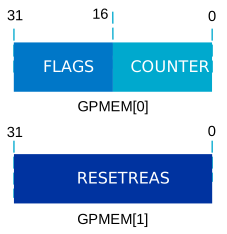
IPC peripheral registers
The GPMEM[0] register is divided into two 16-bit parts.
The COUNTER value is incremented by the network core every CONFIG_NCM_FEEDING_INTERVAL_MSEC.
If the network core is suspended, the counter value is not updated.
The FLAGS field has the Reset flag as the bit 0.
The reset bit is set at the boot of the network core. It informs the application core that a reset of the network core has occurred.
During the startup of the network core, the reset bit is set and the cause of the reset is written to the IPC register GPMEM[1].
This value is rewritten from the network core’s RESET.RESETREAS register.
For a detailed description of the bits in this register, see the RESETREAS section for nRF5340.
The ncm_net_core_event_handler() function may be implemented by your application.
On the application core, the network core monitor checks the values of IPC registers written by the network core every CONFIG_NCM_FEEDING_INTERVAL_MSEC.
If the network core malfunctions and fails to increment the COUNTER value, the ncm_net_core_event_handler() function is called on the application core.
This function is also called when the network core is restarted.
The network core monitor provides a __weak implementation of that function in the nrf/subsys/net_core_monitor/app_core.c file.
The following events are supported and also listed in the nrf/include/net_core_monitor.h file:
NCM_EVT_NET_CORE_RESETEvent triggered when a network core reset occurs.
The
reset_reasvariable holds the reason for the reset. It is rewritten from theRESET.RESETREASregister.
NCM_EVT_NET_CORE_FREEZEEvent triggered when the network core is not responding.
Configuration
To enable this library, set the CONFIG_NET_CORE_MONITOR Kconfig option to y on both network and application cores.
The CONFIG_NCM_FEEDING_INTERVAL_MSEC Kconfig option specifies how often the counter is updated by the network core.
The default value is 500 milliseconds.
The CONFIG_NCM_RESET_INIT_PRIORITY Kconfig option sets priority for the initialization function.
The function reads the cause of the processor reset and passes this information to the application core.
It is executed at the network core boot.
Usage
To enable the Network core monitor library, set the CONFIG_NET_CORE_MONITOR Kconfig option.
The ncm_net_core_event_handler() function can be used to notify the application about the status of the network core.
To define the user action for the event, you must override the __weak function definition of ncm_net_core_event_handler().
Otherwise, the __weak` definition is called and it prints information about the event.
See the following usage example.
#include "net_core_monitor.h"
...
/* This is the override for the __weak handler. */
void ncm_net_core_event_handler(enum ncm_event_type event, uint32_t reset_reas)
{
   switch (event) {
   case NCM_EVT_NET_CORE_RESET:
      printk("The network core reset.\n");
      /* do something */
      break;
   case NCM_EVT_NET_CORE_FREEZE:
      printk("The network core is not responding.\n");
      /* do something */
      break;
   }
}
Dependencies
The module uses two general-purpose registers, GPMEM[0] and GPMEM[1], of the application core’s IPC peripheral.
API documentation
include/net_core_monitor.hsubsys/net_core_monitor/