

Cygnet
Overview
The Blues Cygnet board features an ARM Cortex-M4 based STM32L433CC MCU with a wide range of connectivity support and configurations. Here are some highlights of the Cygnet board:
STM32L4 microcontroller in LQFP48 package
Adafruit Feather connector
User LED
User push-button
USB Type-C connector
More information about the board can be found at the Blues Cygnet website [1].
Hardware
The STM32L433CC SoC provides the following hardware IPs:
Ultra-low-power with FlexPowerControl (down to 28 nA Standby mode and 84 µA/MHz run mode)
Core: ARM® 32-bit Cortex®-M4 CPU with FPU, frequency up to 80 MHz, 100DMIPS/1.25DMIPS/MHz (Dhrystone 2.1)
Clock Sources:
32 kHz crystal oscillator for RTC (LSE)
Internal 16 MHz factory-trimmed RC (±1%)
Internal low-power 32 kHz RC (±5%)
Internal multispeed 100 kHz to 48 MHz oscillator, auto-trimmed by LSE (better than ±0.25 % accuracy)
2 PLLs for system clock, USB, audio, ADC
RTC with HW calendar, alarms and calibration
11x timers:
1x 16-bit advanced motor-control
1x 32-bit and 2x 16-bit general purpose
2x 16-bit basic
2x low-power 16-bit timers (available in Stop mode)
2x watchdogs
SysTick timer
Up to 21 fast I/Os, most 5 V-tolerant
Memories
Up to 256 KB single bank Flash, proprietary code readout protection
64 KB of SRAM including 16 KB with hardware parity check
Rich analog peripherals (independent supply)
1x 12-bit ADC 5 MSPS, up to 16-bit with hardware oversampling, 200 µA/MSPS
2x 12-bit DAC output channels, low-power sample and hold
1x operational amplifiers with built-in PGA
2x ultra-low-power comparators
17x communication interfaces
USB 2.0 full-speed crystal less solution with LPM and BCD
1x SAI (serial audio interface)
3x I2C FM+(1 Mbit/s), SMBus/PMBus
4x USARTs (ISO 7816, LIN, IrDA, modem)
1x LPUART (Stop 2 wake-up)
3x SPIs (and 1x Quad SPI)
CAN (2.0B Active)
14-channel DMA controller
True random number generator
CRC calculation unit, 96-bit unique ID
Development support: serial wire debug (SWD), JTAG, Embedded Trace Macrocell*
More information about STM32L433CC can be found here:
Supported Features
The cygnet board supports the hardware features listed below.
- on-chip / on-board
- Feature integrated in the SoC / present on the board.
- 2 / 2
-
Number of instances that are enabled / disabled.
Click on the label to see the first instance of this feature in the board/SoC DTS files. -
vnd,foo -
Compatible string for the Devicetree binding matching the feature.
Click on the link to view the binding documentation.
Note
CAN feature requires a CAN transceiver.
Connections and IOs
The Cygnet board has 6 GPIO controllers. These controllers are responsible for pin muxing, input/output, pull-up, etc.
Available pins
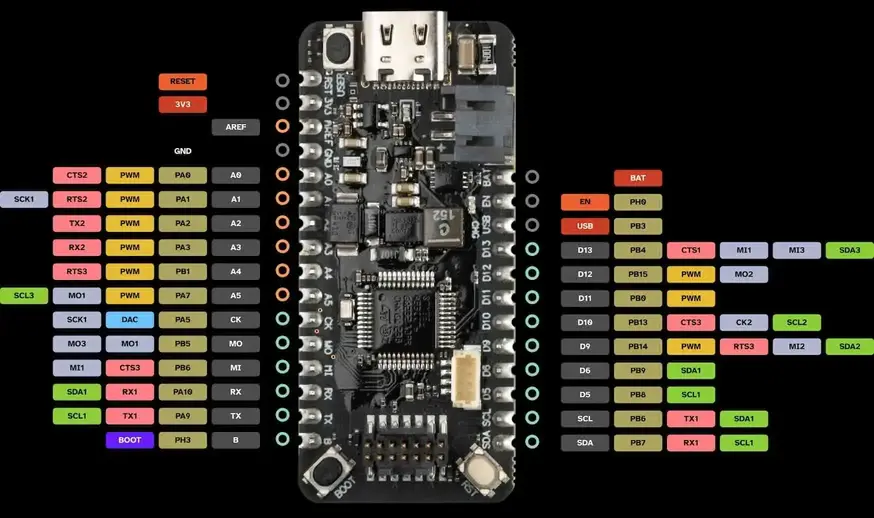
For more details please refer to Blues Cygnet User Manual [2].
Default Zephyr Peripheral Mapping
LPUART_1_TX : PB11
LPUART_1_RX : PB10
UART_1_TX : PA9
UART_1_RX : PA10
I2C_1_SCL : PB6
I2C_1_SDA : PB7
PWM_2_CH1 : PA0
SPI_1: SCK/MISO/MOSI : PA5/PA6/PB5
System Clock
The Cygnet board System Clock could be driven by internal or external oscillator, as well as main PLL clock. By default System clock is driven by PLL clock at 80MHz, driven by 16MHz high speed internal oscillator.
Serial Port
The Cygnet board has 4 U(S)ARTs and 1 LPUART. The Zephyr console output is assigned to LPUART1. Default settings are 115200 8N1.
Programming and Debugging
The Cygnet board requires an ST-LINK embedded debug tool in order to be programmed and debugged.
Applications for the cygnet board configuration can be built and
flashed in the usual way (see Building an Application and
Run an Application for more details).
Flashing
The board is configured to be flashed using west STM32CubeProgrammer [5] runner, so its installation is required.
Alternatively, OpenOCD or JLink can also be used to flash the board using
the --runner (or -r) option:
$ west flash --runner openocd
$ west flash --runner jlink
Flashing an application to Cygnet
Connect the Cygnet to the ST-LINK debugger, then run a serial host program to connect with your Cygnet board.
$ picocom /dev/ttyACM0 -b 115200
Now build and flash an application. Here is an example for Hello World.
# From the root of the zephyr repository
west build -b cygnet samples/hello_world
west flash
You should see the following message on the console:
$ Hello World! cygnet
Debugging
You can debug an application in the usual way. Here is an example for the Hello World application.
# From the root of the zephyr repository
west build -b cygnet samples/hello_world
west debug