

Nucleo F446ZE
Overview
The Nucleo F446ZE board features an ARM Cortex-M4 based STM32F446ZE MCU with a wide range of connectivity support and configurations. Here are some highlights of the Nucleo F446ZE board:
STM32F446 microcontroller in QFP144 package
Two types of extension resources:
ST zio support for Arduino™ Uno V3 connectivity (A0 to A5, D0 to D15) and additional signals exposing a wide range of peripherals
ST morpho extension pin headers for full access to all STM32 I/Os
On-board ST-LINK/V2-1 debugger/programmer with SWD connector
USB re-enumeration capability. Three different interfaces supported on USB: - Virtual Com port - Mass storage (USB Disk drive) for drag’n’drop programming - Debug port
Flexible board power supply: - USB VBUS or external source(3.3V, 5V, 7 - 12V) - Power management access point - USB OTG
Three LEDs: USB communication (LD1), user LED (LD2), power LED (LD3)
Two push-buttons: USER and RESET
More information about the board can be found at the Nucleo F446ZE website.
Hardware
Nucleo F446ZE provides the following hardware components:
STM32F446ZET6 in LQFP144 package
ARM® 32-bit Cortex®-M4 CPU with FPU
Adaptive real-time accelerator (ART Accelerator)
180 MHz max CPU frequency
VDD from 1.7 V to 3.6 V
512 KB Flash
128 KB SRAM
10 General purpose timers
2 Advanced control timers
2 basic timers
SPI(4)
I2C(4)
USART(4)
UART(2)
USB OTG Full Speed and High Speed
CAN(2)
SAI(2)
SPDIF_Rx(1)
HDMI_CEC(1)
Quad SPI(1)
Camera Interface
GPIO(50) with external interrupt capability
12-bit ADC(3) with 16 channels
12-bit DAC with 2 channels
More information about STM32F446ZE can be found here:
Supported Features
The nucleo_f446ze board supports the hardware features listed below.
- on-chip / on-board
- Feature integrated in the SoC / present on the board.
- 2 / 2
-
Number of instances that are enabled / disabled.
Click on the label to see the first instance of this feature in the board/SoC DTS files. -
vnd,foo -
Compatible string for the Devicetree binding matching the feature.
Click on the link to view the binding documentation.
Connections and IOs
Nucleo F446ZE Board has 8 GPIO controllers. These controllers are responsible for pin muxing, input/output, pull-up, etc.
Available pins:
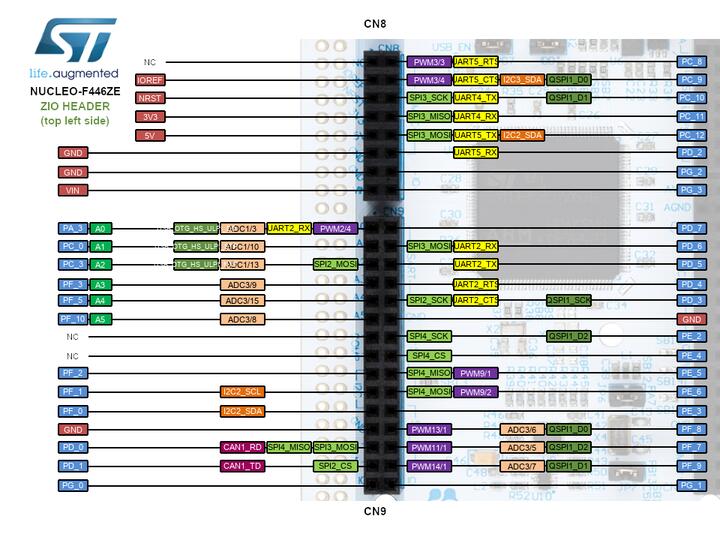
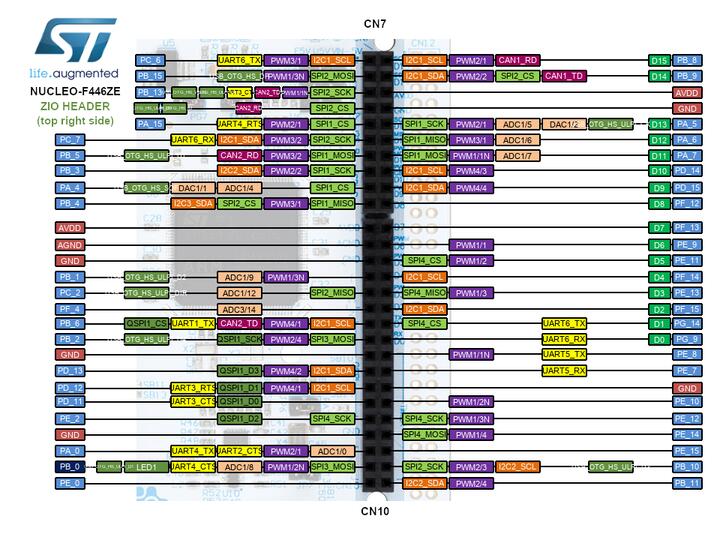
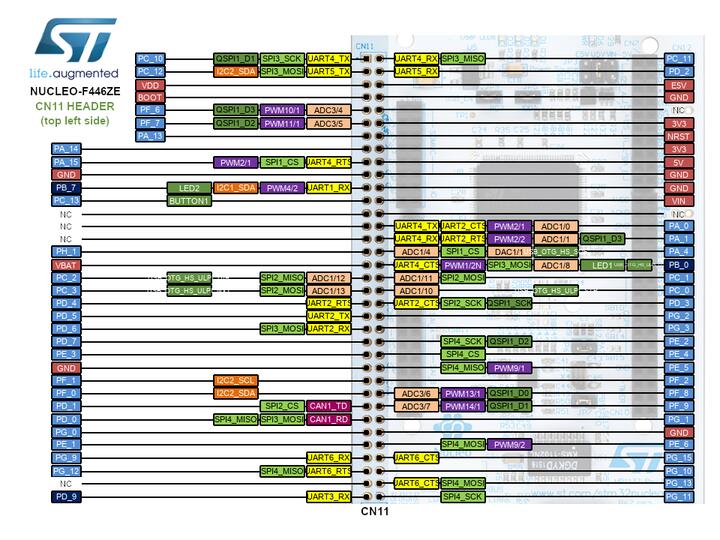
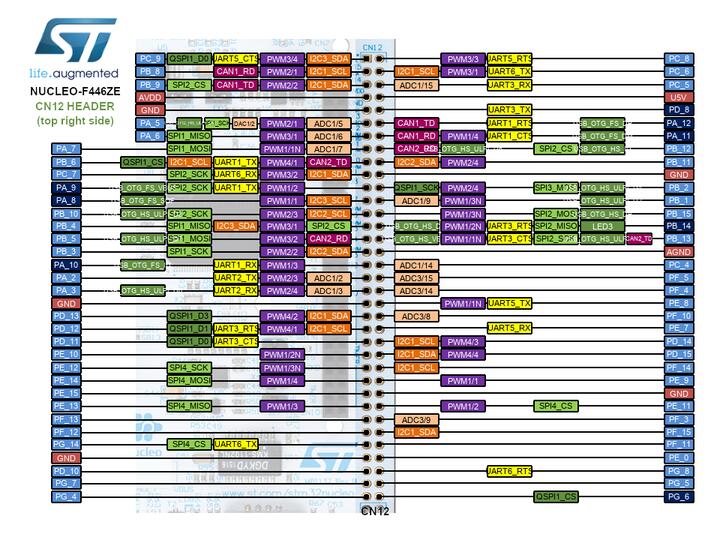
For more details please refer to STM32 Nucleo-144 board User Manual.
Default Zephyr Peripheral Mapping:
UART_2_TX : PD5
UART_2_RX : PD6
UART_3_TX : PD8
UART_3_RX : PD9
USER_PB : PC13
LD0 : PB0
LD1 : PB7
LD2 : PB14
I2C1_SDA : PB9
I2C1_SCL : PB8
I2C2_SDA : PF0
I2C2_SCL : PF1
SPI1_CS : PD14
SPI1_SCK : PA5
SPI1_MISO : PA6
SPI1_MOSI : PA7
SPI2_NSS : PB12
SPI2_SCK : PB13
SPI2_MISO : PB14
SPI2_MOSI : PB15
CAN1_RX : PD0
CAN1_TX : PD1
USB_DP : PA11
USB_DM : PA12
ADC1_IN0 : PA0
DAC_OUT1 : PA4
System Clock
Nucleo F446ZE System Clock could be driven by an internal or external oscillator, as well as the main PLL clock. By default, the System clock is driven by the PLL clock at 84MHz, driven by an 8MHz high-speed external clock.
Serial Port
Nucleo F446ZE board has 2 UARTs and 4 USARTs. The Zephyr console output is assigned to USART3. Default settings are 115200 8N1.
Backup SRAM
In order to test backup SRAM you may want to disconnect VBAT from VDD. You can
do it by removing SB156 jumper on the back side of the board.
Controller Area Network
The TX/RX wires are connected with pins 25/27 of CN9 connector.
Programming and Debugging
The nucleo_f446ze board supports the runners and associated west commands listed below.
| flash | debug |
|---|
Nucleo F446ZE board includes an ST-LINK/V2-1 embedded debug tool interface.
Applications for the nucleo_f446ze board configuration can be built and
flashed in the usual way (see Building an Application and
Run an Application for more details).
Flashing
The board is configured to be flashed using west STM32CubeProgrammer runner, so its installation is required.
Alternatively, OpenOCD or JLink can also be used to flash the board using
the --runner (or -r) option:
$ west flash --runner openocd
$ west flash --runner jlink
Flashing an application to Nucleo F446ZE
Here is an example for the Hello World application.
Run a serial host program to connect with your Nucleo board.
$ minicom -b 115200 -D /dev/ttyACM0
Build and flash the application:
# From the root of the zephyr repository
west build -b nucleo_f446ze samples/hello_world
west flash
You should see the following message on the console:
$ Hello World! arm
Debugging
You can debug an application in the usual way. Here is an example for the Hello World application.
# From the root of the zephyr repository
west build -b nucleo_f446ze samples/hello_world
west debug