

TQ H503A
Overview
The Embedsky TQ-H503A board is an extremely low cost and bare-bones development board featuring an ARM® Cortex®-M33 core-based STM32H503CBT6 microcontroller, see STM32H503CB website [1]. This is the 48-pin variant of the STM32H503x series, see STM32H503x reference manual [2]. Here are some highlights of the TQ-H503A board:
STM32H503CB microcontroller with 128 Kbytes of Flash memory and 32 Kbytes of SRAM in LQFP48 package
One user LED
32.768 kHz crystal oscillator
8 MHz HSE crystal oscillator
Hardware
The STM32H503CB belongs to the high-performance microcontroller family (STM32H5 series) based on the high-performance Arm® Cortex®-M33 32-bit RISC core. They operate at frequency of up to 250 MHz.
Core: Arm® Cortex®-M33 CPU with FPU, MPU, 375 DMIPS (Dhrystone 2.1), and DSP instructions
ART Accelerator
Memories
128 Kbytes of embedded flash memory with ECC, two banks of read-while-write
2-Kbyte OTP (one-time programmable)
32-Kbyte SRAM with ECC
2 Kbytes of backup SRAM (available in the lowest power modes)
Clock management
Internal oscillators: 64 MHz HSI, 48 MHz HSI48, 4 MHz CSI, 32 kHz LSI
Two PLLs for system clock, USB, audio, and ADC
External oscillators: 4 to 50 MHz HSE, 32.768 kHz LSE
Embedded regulator (LDO)
35 fast I/Os (most 5 V tolerant)
Analog peripherals
1x 12-bit ADC with up to 2.5 MSPS
1x 12-bit dual-channel DAC
1x ultra-low-power comparator
1x operational amplifier (7 MHz bandwidth)
1x Digital temperature sensor
11 timers - 4x 16-bit - 1x 32-bit - 2x 16-bit low-power 16-bit timers (available in Stop mode) - 2x watchdogs - 1x SysTick timer - RTC with HW calendar, alarms and calibration
16x communication interfaces
2x I2Cs FM + interfaces (SMBus/PMBus®)
2x I3Cs shared with I2C
3x USARTs (ISO7816 interface, LIN, IrDA, modem control)
1x LPUART
3x SPIs including three muxed with full-duplex I2S
3x additional SPI from 3x USART when configured in synchronous mode
1x FDCAN
1x USB 2.0 full-speed host and device
Two DMA controllers to offload the CPU
Security
HASH (SHA-1, SHA-2), HMAC
True random generator
96-bit unique ID
Active tamper
Development support: serial wire debug (SWD) and JTAG interfaces
Supported Features
The tq_h503a board supports the hardware features listed below.
- on-chip / on-board
- Feature integrated in the SoC / present on the board.
- 2 / 2
-
Number of instances that are enabled / disabled.
Click on the label to see the first instance of this feature in the board/SoC DTS files. -
vnd,foo -
Compatible string for the Devicetree binding matching the feature.
Click on the link to view the binding documentation.
Pin Mapping
Available pins:
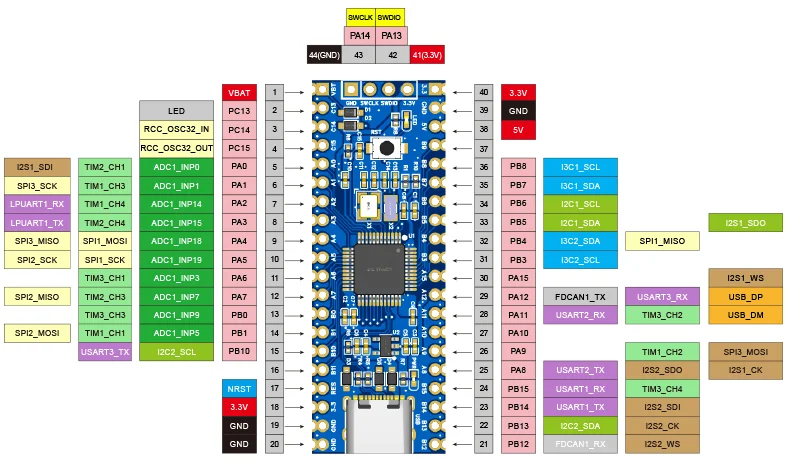
Default Zephyr Peripheral Mapping:
UART_1 TX/RX : PB14/PB15
USER_LED : PC13
I2C1 SCL/SDA : PB6/PB5
SPI1 SCK/MISO/MOSI : PA5/PB4/PA4 (Routed to footprint for external flash)
Clock Sources
The board has two external oscillators. The slow clock (LSE) runs at 32.768 kHz. The main clock (HSE) runs at 8 MHz.
By default, the system clock is sourced from the PLL, derived from HSE and set to 250 MHz.
Programming and Debugging
The tq_h503a board supports the runners and associated west commands listed below.
| flash | debug |
|---|
Applications for the tq_h503a board can be built and
flashed in the usual way (see Building an Application and
Run an Application for more details).
OpenOCD Support
Currently, upstream OpenOCD does not yet support STM32H5 devices. You can check the OpenOCD official Github mirror [3] for updates. To use OpenOCD with this board, clone the customized STMicroelectronics OpenOCD Github [4] repo and build it following the README. Once compiled, set the and OPENOCD_ROOT variables in boards/embedsky/tq_h503a/board.cmake to point to the OpenOCD binary and its scripts, before including the common openocd.board.cmake file:
set(OPENOCD_ROOT "<path_to_openocd_stm32_repo>")
set(OPENOCD "${OPENOCD_ROOT}/src/openocd" CACHE FILEPATH "" FORCE)
set(OPENOCD_DEFAULT_PATH ${OPENOCD_ROOT}/tcl)
Flashing
The board is configured for flashing using west openocd runner via ST-LINK:
$ west flash
Flashing an application to TQ-H503A
Attach an SWD debugger (ST-LINK) to the 3V3 (3.3V), GND, SCK, and DIO pins on the board.
Connect the debugger to your host via USB, then build and flash your application. For example, to flash the Hello World application.
Start a serial host program to connect to the debugger’s VCP:
$ minicom -D /dev/ttyACM0
Then build and flash the app:
# From the root of the zephyr repository
west build -b tq_h503a samples/hello_world
west flash
You should see the following message on the console:
Hello World! tq_h503a/stm32h503xx
Debugging
You can debug applications in the usual way. Here is an example for the Blinky application.
# From the root of the zephyr repository
west build -b tq_h503a samples/basic/blinky
west debug